


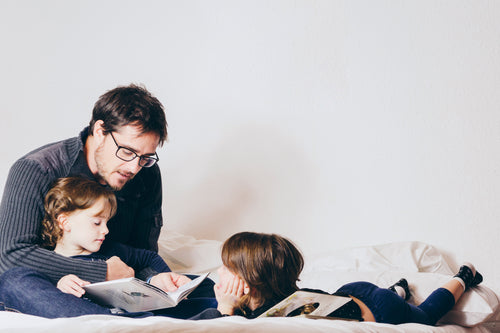
Developing a thirst for reading
24 August, 2018
Reading, we can't say it enough, helps children develop their skills by leaps and bounds! And not just in language class.
Simply letting your baby hold a book, even upside down, and flip through it a little clumsily will eventually allow them to develop a curiosity for words, pictures, language and all the imagination that surrounds this educational and playful activity.
Reading is everywhere in our environment: at school, later at work, on the road, at restaurants, on television, and now more and more in parks and everywhere else!
I keep repeating how invaluable a learning tool reading is, and that it's therefore essential to include it as often as possible in children's daily lives. So I thought I'd give you a few pointers for building a positive relationship between your children and reading.
If you place importance on reading itself, you should carry the same attitude over to how you set up your reading area. To make a good first contact with books, it helps to create a comfortable, pleasant and peaceful environment where relaxation and concentration can come together. Create a cozy lounge area by putting cushions on the floor, hang a chair from the ceiling, set up a rocking chair in the sunroom or a mattress in the basement, add a comforting scent and a good accent light to make reading easier, and you're all set! Choose a room away from the hubbub of the kitchen and the common areas of the house so the whole family can retreat to a little haven of peace when the interest strikes.
Encourage without forcing. Make room for reading in your daily routine and your child's. If it's not on the schedule, it's usually the first activity to go out the window when time is short, when it should stay on the schedule unless there's a real emergency. Don't pressure your child if they don't feel like reading one evening this week; you'll only create a negative association. They'll read out of obligation, not out of desire.
Don't discriminate based on the type of book chosen. A novel is just as educational a read as a comic book or a fashion magazine. What matters is developing a taste for punctuation, for the mental images that reading creates and a desire to learn.
Of course, we have to agree that it's necessary to pre-select books (and magazines) that match the child's reading abilities. If the reading material available to them has vocabulary that's too advanced, you won't be any further ahead, and the child will certainly tend to get discouraged by the difficulty of reading the words properly and understanding the meaning of what's described. For toddlers, I encourage you to favour books with pictures to hold their attention and their wonder at the drawings and colours they contain. You can also prioritize books with themes that are part of their interests. Also make sure (and above all) to leave books within the child's reach.
Sensing boredom and a loss of motivation after a few weeks of practice? Don't hesitate to rotate the books available (don't put all the books at the child's disposal at the same time) and to visit your neighbourhood library to browse the new books and take part in story hours or first book readings with your older ones.
Happy reading!
Would you like first access to all the content published in the Magazine each month, plus our Toolbox, which includes, among other things, free downloads that are as practical as they are fun? Subscribe to Belles Combines Magazine today!

Put these tips into practice
Get the whole family organized with Octave
Meals, chores, the calendar and routines for the whole family in one place: on everyone's phone and on the Station on your wall.
The app is free on iOS and Android.