



Homework: tips and tricks to make it enjoyable
05 September, 2017
Well before getting down to work and tackling homework, it's important to create a positive atmosphere that's conducive to working. Take the time to chat with your child and invite them to tell you about their day and what they learned at school. That way, they'll see that you're interested in their daily life and their learning. Encourage and value your little one's efforts. Praise them when they finish a task on their own or stick with a harder one.
When kids go to school, homework and study time inevitably follow! If this time of day is tough or full of conflict at your place, here are a few little ideas to try to make it a bit more pleasant. Keep in mind, though, that these are only suggestions, not magic formulas. Depending on each family's situation, some of the ideas here may be harder to put in place. But whatever you do, don't give up; there are bound to be a few little tricks that speak to you and are a better fit for your family!
Tips and tricks to make homework time more enjoyable
First of all, a little snack before getting started is always welcome! Nobody can concentrate when they're starving! It's also better to eat a little something before getting to work rather than having to stop partway through.
A quick potty break after snack time, and we're ready to start! Let's go!
Your child's day is full of routines: the morning routine, routines at school (for lining up, moving around, free time, etc.), the bedtime routine… They make your child's day more predictable and help them become more independent. Why not set up a routine for homework and study time? For more anxious kids, a routine helps them feel secure and eases their anxiety, while making them more ready to focus on the task. Try drawing up a list of the homework and studying to be done each evening so your child can come and check off each task once it's done, which lets them see how much there is to do and gives them a certain sense of control.
If homework time is a daily battle, it would be wise to take the time to talk it over with your child to understand the “real” reasons behind their frustration. Help them put their discomfort or anxiety into words. Do they feel pressured? Do they find the work too hard? Are they afraid of disappointing you or their teacher? Once you know what's bothering them, it'll be easier to adjust your approach.
If the work seems too long or too hard, you can break it down to make it more manageable for your child. You can also give them breaks between tasks so they don't hit cognitive overload. Finally, don't hesitate to offer little rewards when they work well. What matters is adapting homework time to your child, and to you.
Strategies to make studying more appealing
Let's take vocabulary words as an example. It's a list that can be longer or shorter depending on your child's grade level. The words may be related to a specific theme (Halloween, family, farm animals, etc.) or chosen for a particular feature (words with a certain sound, an “m” before a “b,” etc.). Your child has to memorize them for the week's spelling recitation or dictation. Your mission: do your very best to help your child remember how to spell all these words!
First, take the time to read the words with them. Usually, the teacher has already gone over them with the class. You can read them once, then ask your child to read them back to you. By reading them, they slowly start to memorize how the words are spelled.
Now the fun part begins! By handling materials, your child will better remember the different letters that make up each word. You can ask them to spell out the words with Scrabble tiles, magnetic letters or bracelet beads (the kind with letters on them). You could also use plastic cups or popsicle sticks on which you've written the letters of the study words ahead of time. You can also have them shape the words out of modelling clay or trace them in flour (or sugar/sand). The idea is for your child to be on the move and actively involved!
It's often said that we remember things best when we learn by doing. With different kinds of materials, your child gets to practise while having fun. You could also make a sort of bingo card with the week's words. You draw one word at a time and your child has to find it on the card. They could also spell out the words while tossing a ball to you, or by jumping with both feet together for each letter. With a little creativity, the possibilities are endless!
Finally, it's important to have them write the words down. At school, they won't have magnetic letters or beads. That doesn't mean writing the words has to be boring! Do you have a chalkboard or whiteboard at home? Why not use it to practise writing the words? Otherwise, you can let your child write the words on a window (with dry-erase markers or ones made especially for glass!). The idea is to switch up the materials for a change from the classic paper and pencil.
Many of the ideas above can also be used to study other concepts (times tables, verb conjugation, memorizing verbs in a second language, etc.). What matters is getting your child moving so they see the task as a game. We learn so much better when we're having fun!
Setting up an effective workspace
Where a child does their homework can vary a lot. Some kids work well at the kitchen table, sitting in the living room or settled in their bedroom. It depends on the child and the task at hand. It can be worthwhile to try out different spots with your child to figure out what they prefer. The important thing is to make conditions as favourable as possible (lighting, noise) and to cut down on distractions.
It's also important for your child to have all the supplies they need for homework within reach. We don't always think of it, but kids sometimes leave their pencil case at school, so plan on having these basics at home:
- Pencils
- Eraser
- Pens
- Highlighters
- Pencil sharpener
- Coloured pencils and markers
- Ruler
- Scissors
- Glue
- Lined paper
For older kids, it can also be handy to keep a calculator and a geometry set (set square, compass, protractor) within reach for math, as well as a dictionary and a Bescherelle (the classic French grammar guide) for French.
Even better, set up a homework independence station with this handy printable! Would you like to always have this printable at your fingertips on your phone? Get it free in our Octave app!
To wrap things up, stay positive and try to have fun! Get creative! That's how you'll nurture your child's love of learning!
Would you like first access to all the content published in the Magazine each month, plus our Toolbox, which includes, among other things, free downloads that are as practical as they are fun? Subscribe to Belles Combines Magazine today!
Put these tips into practice
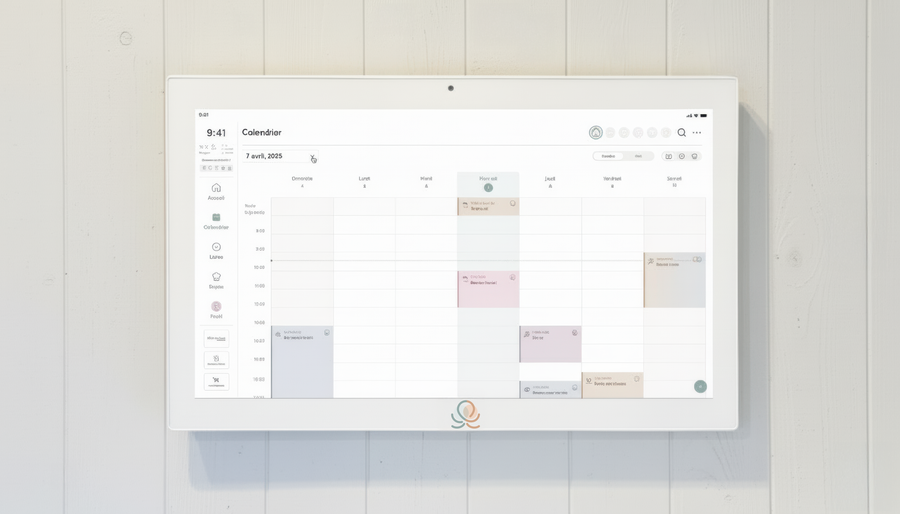
Get the whole family organized with Octave
Meals, chores, the calendar and routines for the whole family in one place: on everyone's phone and on the Station on your wall.
The app is free on iOS and Android.