



Parental authority: choosing a caring approach
21 September, 2018
As parents, we have an essential role to play in our children's lives: giving them tools so they're ready to take the next step in their lives. Depending on the circumstances, our personality, our own experience and our baggage, we have of course developed a parenting style all our own. These different parenting styles all lie somewhere on the line between dictatorship and permissiveness. On one side, the adult decides and the child submits to those decisions, while at the other end of the spectrum, the child decides and the parent submits to the child's wishes and whims. Somewhere between the two lies a caring approach.
Many parents mistakenly believe that caring parenting is parenting without limits, where the parent must stay attentive to their little king or queen, to their stories and to all of their emotions without limits. Fortunately, that's not the case. Being caring is instead about looking out for the child's well-being, and that well-being also comes through “no”s, “stop”s and limits.
So what sets caring parenting apart from authoritarian or permissive parenting?
In caring parenting, there's a lot of communication, exchange of points of view, trial and error, and a great deal of humility and acceptance. And this caring must begin with ourselves first.
Recognizing imperfection
It's quite a challenge to recognize that we are imperfect beings. However, this recognition is healthy because it means we feel less guilt and are more inclined to take action to correct problem situations or mistakes we've made. What's more, not only will recognizing our imperfection let us feel better in our role as parents, it will also make it easier to accept our children's imperfections. Our demands, thus adjusted, can be better adapted to their level of development. How many episodes of stress, anguish and anxiety are spared simply by acknowledging that we're imperfect and ceasing to seek perfection! Yes, we make mistakes. Yes, we fail. So, ready, set, go: we get back up, readjust and take the next call. Curling up in a ball or beating ourselves up won't change anything, except to make us dwell on the gloom and reinforce a negative image of ourselves.
Showing humility
To stay in caring parenting, it's important that we can set our ego aside and be able to admit our mistakes. First, for ourselves, it's the most effective way to improve. You can't change what you don't acknowledge. Denying, deflecting or trying to cover up our mistakes and inappropriate reactions only keeps us stuck in that behaviour pattern. Second, for our children, hearing a parent admit to a mistake – a parent who is a god in their child's eyes – lets them develop that humility too. They see that an adult can be wrong and that to correct course, it's important to acknowledge one's mistakes and act accordingly.
Developing our acceptance
First, you need to know that acceptance is not at all synonymous with approval. When I talk about acceptance here, I mean acknowledging the facts for what they are, noting them. We can't change what has happened. Refusing to accept this makes us feel anger, and that anger builds nothing positive. So it's important to distinguish between acceptance and approval.
In acceptance, I focus my attention on the facts:
- I notice that you hit your brother.
- I understand that you don't want to go anymore.
- I hear that this doesn't suit you.
- I see that you're upset.
Acknowledging this reality will help the child become aware of what's happening. Then comes your judgment of the behaviour.
- However, I disapprove of this act of violence.
- Nevertheless, I think it's important that you keep your commitments.
- Despite that, I've decided that this is where we're going.
- I refuse to let you throw your toys at me.
Since caring starts with ourselves, start by identifying 10 things you can do to feel good. Then set aside 30 minutes a day to do them. It's not easy, you'll see, but if you stick with it, you'll get a taste for it, you'll feel good and, once fulfilled, you'll feel less like you're giving to everyone and are empty when it comes time for you.
Want to be the first to see everything published in the Magazine each month, and get access to our Toolbox, which includes, among other things, free downloads that are as practical as they are fun? Subscribe to Belles Combines Magazine today!
Put these tips into practice
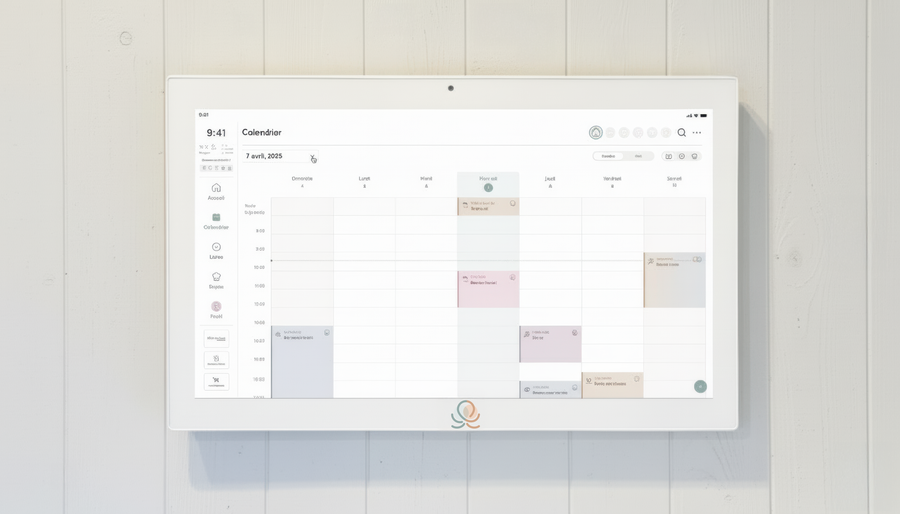
Get the whole family organized with Octave
Meals, chores, the calendar and routines for the whole family in one place: on everyone's phone and on the Station on your wall.
The app is free on iOS and Android.