



Managing clothes: the Sudoku method
30 August, 2026
Between clothes that are too small, those waiting for the right season, those we keep “just in case” and those we can never find when we need them, managing a family's clothes can quickly turn into a real puzzle. And just like a sudoku, the solution isn't found by solving one square at a time at random, but by thinking about the whole grid. That's exactly the idea behind the Sudoku method: organizing the whole family's clothes by crossed categories, a bit like the rows and columns of a grid, so that every piece of clothing always has a logical place.
The basic principle
In a sudoku, every number has to find its precise place according to its row, its column and its box. The method applied to clothes works on the same principle: each item of clothing is sorted along three axes that cross, rather than by a single criterion (as we often do by simply separating by person or by season).
The three axes to combine:
👤 The person: who the clothing belongs to
📅 The season: which time of year it's meant for
📏 The current size: worn now, coming soon, or to give away
By crossing these three categories rather than using just one, every piece of clothing ends up with a very specific square, which eliminates a good part of the chaos that builds up in drawers and closets.
Setting up the grid
You don't need a complicated system or an elaborate Excel spreadsheet to get started. Here's how to physically set up this grid in the house:
- Clearly labelled bins or sections for each child, separated by season (summer/winter or all four seasons depending on your climate)
- A “next size” zone: clothes that are too big for now but will be useful soon, stored out of the way so they don't clutter the active drawers
- A “to give away or sell” zone: clothes that are too small, to be taken out of the house as soon as it's full rather than letting it pile up
- Visible labels on every bin, with the size and season clearly written, so you don't have to open everything to remember what's inside
Rotating at the change of seasons
The real advantage of the Sudoku method shows up at the change of seasons, when the grid lets you reorganize everything quickly rather than emptying every drawer in a mess:
- Take out the bin for the coming season and set it up in the active drawers
- Sort quickly: what still fits, what doesn't fit anymore, what's damaged
- Move clothes that are too small to the “to give away” zone
- Pack away the season that's ending in a labelled bin for next year
- Check the “next size” zone to see whether any clothes can now join the active rotation
This step usually takes less than an hour once the structure is in place, compared to several hours (and a lot of frustration) when everything is mixed together.
Getting the kids involved in the system
As with a real sudoku, the better you understand the system's logic, the easier it is to keep up. Kids, even young ones, can take part:
- Sort their own clothes according to what still fits them and what doesn't
- Put their clean laundry straight into the right bin
- Choose which clothes to give away among those that have become too small
- Decorate or write their own bin labels
Adapting the grid to your reality
The beauty of this method is that it's easy to customize to each family's needs. A family with several children close in age can add a column for clothes that get handed down from one child to the next. A family in a climate with less pronounced seasons can simplify the grid to two categories instead of four. The important thing isn't to follow the system to the letter, but to keep this crossing logic that spares you from sorting everything from scratch every season.
Like a well-solved sudoku, a well-organized family wardrobe brings a simple but real satisfaction: everything has its place, nothing gets lost, and you gain precious time you can spend on something other than hunting for mismatched socks. 🧦🧩
Put these tips into practice
Get the whole family organized with Octave
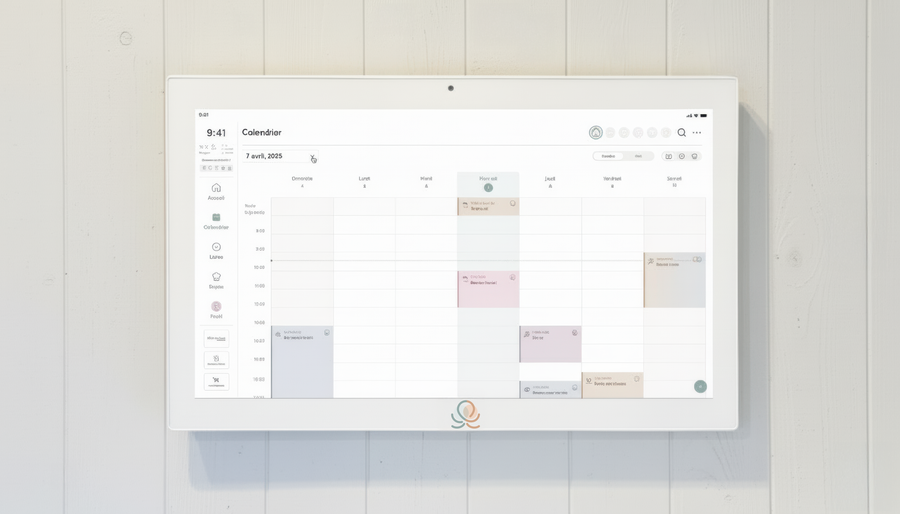
Meals, chores, the calendar and routines for the whole family in one place: on everyone's phone and on the Station on your wall.
The app is free on iOS and Android.