



Habits that free up time: the “Never Empty-Handed” principle
01 April, 2025
By Dominique Bernèche
In the first two articles of this special feature, we explored the dangers of overloaded schedules and discovered how to build “productivity-free zones” into our family organization. A legitimate question then arises: how do we carve out time for these precious bubbles of breathing room?
Careful, though: this isn't about falling into the trap of a new obsession – that of perpetual hyper-efficiency. The nuance is crucial: efficiency becomes truly beneficial when we can tell the moments when we need to be productive from those when we need to let go. It's precisely this smart alternation that creates balance. Being strategically efficient at certain tasks is exactly what lets us create those spaces of freedom elsewhere in our schedule.
So the answer isn't to run faster on our daily hamster wheel, but to adopt smart micro-habits that optimize our time without wearing us out. It's about being intensely efficient when we work, so we can be fully present when we rest.
The St-Hubert philosophy: “Never empty-handed”
While I was in university, I worked at St-Hubert Barbecue, the Quebec rotisserie chain. What seemed like a simple student job turned out to be a true school of productivity. The fundamental principle? “Never empty-handed.” In the kitchen, on the floor, while clearing tables – every trip had to serve a purpose. Picking up a plate on the way past, dropping off a condiment while heading somewhere else, helping a coworker when you had a free moment.
What makes this system strong is that it relies on collective dynamics. Just like in our families! If only one server applied this principle while the others each worked for themselves, overall efficiency would remain mediocre. It's precisely when the whole team – or the whole family – adopts these micro-habits that the magic happens.
Okay, it's not easy to put in place with kids and teens, I'll admit... but let's try. Picture a home where everyone, from the youngest to the oldest, gradually builds in these efficiency reflexes: a child who picks up a toy on the way up to their room, a teen who starts a load of laundry on the way to get a glass of water, a parent who tidies up quickly while the tea water heats. With no extra effort, but with some collective orchestration (and lots of patience!), the savings in time and energy become significant.
The first two weeks of training were so intense that tears were shed (literally). But that experience forged an approach to efficiency that I still apply today. The idea isn't to wear yourself out doing everything at once, but to eliminate unnecessary movements and optimize every trip, every moment.
How do we apply this philosophy to our home life without turning our home into a stressful professional kitchen? Here are some concrete micro-habits inspired by this principle that free up time without adding pressure.
The micro-routines that change everything
1. Optimizing your trips
The “never empty-handed” principle applied at home can transform your efficiency with no extra effort:
-
The stairs-to-bedroom trip: Never go up the stairs without taking something that belongs upstairs (clean clothes, stray objects, etc.)
-
The “one for one” rule: Every time you enter a room, pick up one thing that doesn't belong there and take it back to where it goes
-
The kitchen-to-living-room trip: Use every pass to bring back a forgotten glass, drop off a piece of fruit for an afternoon snack, etc.
A mother of three once told me: “I hung a box at the bottom of the stairs where the whole family drops the things that need to go up. Whenever someone goes up, they take one or two items from the box. It's become automatic, and our stairs no longer look like an obstacle course!”
2. Double-duty moments in the kitchen
The kitchen is the ideal place to apply the principle of smart productivity:
-
Cook hard-boiled eggs while you boil pasta – same pot, same energy, two preparations
-
Make double the rice or quinoa – one cook, two meals
-
Choose meals in pairs that use similar ingredients – two meals with cauliflower, two meals with chicken. One food prep, two meals
-
Wash the dishes while the food cooks – two actions, one moment
Bonus tip: When I have an efficient weekly menu that went over well, I duplicate it in Octave every month. That way, one round of prep gets used several times over.
3. Optimized hygiene routines
These mandatory daily moments can become opportunities for efficiency:
-
Clean the shower while your hair mask sets (a perfect 2-in-1: while the product works, you're already in the shower)
-
Brush your teeth while tidying the bathroom counter (those 2 minutes a day add up to 12 hours a year!)
-
Fold laundry while the kids take their bath (you stay available for safety while being productive)
-
Put up a whiteboard in the bathroom to jot down ideas in the shower or quiz the kids on their multiplication tables while they brush their teeth
“I started doing my squats and lunges while I brush my teeth,” says one father. “It doesn't replace a real workout, but I'm racking up 10 minutes of exercise a day without even thinking about it.”
Time-savers with young children: the magic of preparing ahead
1. Hassle-free meal prep
Preparing meals in advance is probably the habit that frees up the most time and reduces the most daily stress:
-
Sunday prep: Cook 2 to 3 main dishes for the week in 2 hours rather than 30 minutes every evening, because we know kids are more demanding at mealtime, especially when they're hungry
-
Prep stations: Set up bins for the next day's lunches and fill them in the evening so the kids can assemble their own lunch in the morning (main dish, snacks, desserts)
-
Ready-to-go snacks: Cut-up vegetables and cubed cheese, portioned individually so the kids can quickly and independently help themselves to snacks
-
Frozen smoothie kits: Prepare bags with all the ingredients for a smoothie, to dump straight into the blender, perfect for not wasting tired fruit
One participant in the family organization workshops shares: “I started preparing ‘dinner kits’ on Sundays: all the ingredients for a meal in one container, with the recipe taped to it. I get home from work, take out my kit, and all I have to do is follow the instructions. The difference in my stress level at 5 p.m. is phenomenal.”
2. Simplified clothing routines
Morning decisions about clothes can use up precious mental energy:
-
The week's outfits: Prepare 5 complete outfits on Sunday (including underwear and socks)
-
The kids' rotation system: Label the kids' drawers by day of the week
-
The “outdoor play” drawer: Set aside a special drawer with clothes that are already worn or stained for playing outside, riding bikes or doing messy activities. No more arguments over “nice clothes” that no one wants to get dirty!
“I set up a ‘clothing formula’ for work: dark pants + colourful top + accessory. No more stress wondering whether this goes with that. Everything is interchangeable and I'm always appropriately dressed for my professional environment.”
The art of delegation and automation
1. Delegating smartly
-
Zones of responsibility: Assign each family member a zone they're fully responsible for and must check every day
-
Parent-child or younger-older sibling duos: Pair a parent and a child for certain chores
-
The “whoever uses it, cleans it” rule: Make everyone accountable for the impact of their activities
One father shares: “We introduced an ‘inspector of the day’ who checks that everything is in order before bedtime. The kids take this role very seriously, and our house is tidier without me having to repeat the same instructions every night.”
2. Automating what can be automated
In our digital age, some tasks can be simplified or automated:
-
Smart grocery lists: Use an app like Octave that lets you reproduce recurring lists
-
Recurring orders: Set up automatic deliveries for products you use constantly (household products, certain staples like coffee)
-
Shared reminders: Set up family alerts for recurring chores
-
Connected routines: Program sequences (lights, thermostat, etc.) for certain times of day
The “batch processing” principle
Grouping similar tasks so you can handle them all at once can transform your efficiency:
-
Admin day: Deal with all the paperwork, emails and bills on the same day
-
Concentrated cleaning session: 30 intense minutes rather than scattered attempts
-
Batched calls: Make all your work or personal calls during one dedicated time slot
-
Strategic shopping trips: Cut down on how often you shop by planning better
A strategy that changed the life of one large family: “We introduced ‘15 minutes on the clock’ every evening at 7:45 p.m. The whole family tidies intensely for exactly 15 minutes, stopwatch in hand. It's short, so nobody complains, but with five people, that adds up to more than an hour of tidying. The impact on our house and our morale is extraordinary.”
The 2-minute rule
It's perhaps the simplest and most powerful technique: if a task takes less than 2 minutes, do it right away. Don't put it off, don't write it down, don't schedule it – just do it on the spot.
Concrete examples:
-
Put the cereal box away rather than leaving it on the counter
-
Reply to that simple message rather than marking it “read later”
-
Sign that school form immediately
-
Hang up your jacket instead of putting it on a chair
“I stuck ‘2 minutes?’ sticky notes all over the house for a month to remind myself of this rule. Now it's become a reflex, and our house stays surprisingly orderly without any particular effort.”
Avoiding the illusion of hyper-efficiency
It's crucial to remember that the goal of these micro-habits isn't to fill our schedules even more, but to free up space for those precious “productivity-free zones” we talked about in the previous article.
As one participant in my workshops pointed out to me: “At first, I used all the time I gained from these techniques to do even more. I ended up exhausted. Now I have a rule: 50% of the time I save goes to breathing moments. If I save 30 minutes thanks to meal prep, 15 minutes will go to reading quietly or simply watching the birds on my patio.”
Conclusion: from efficiency to presence
The ultimate goal of all these micro-habits isn't to turn your home into an ultra-high-performance factory, but to create pockets of space and time where you can be fully present – for yourselves and for one another.
As one mother sums it up admirably: “Before, I was chasing time. Now, thanks to these small accumulated habits, I feel like time is walking beside me. I'm not more high-performing for the sake of being more high-performing – I'm more efficient so I can be more present.”
In the next article in our feature, we'll explore how to instill this philosophy of a schedule that breathes for the long term, by creating a true “family meeting” that watches over the maintenance of this precious balance.
This article is part of our special feature “A Family Schedule That Breathes,” published in the April 2025 issue.
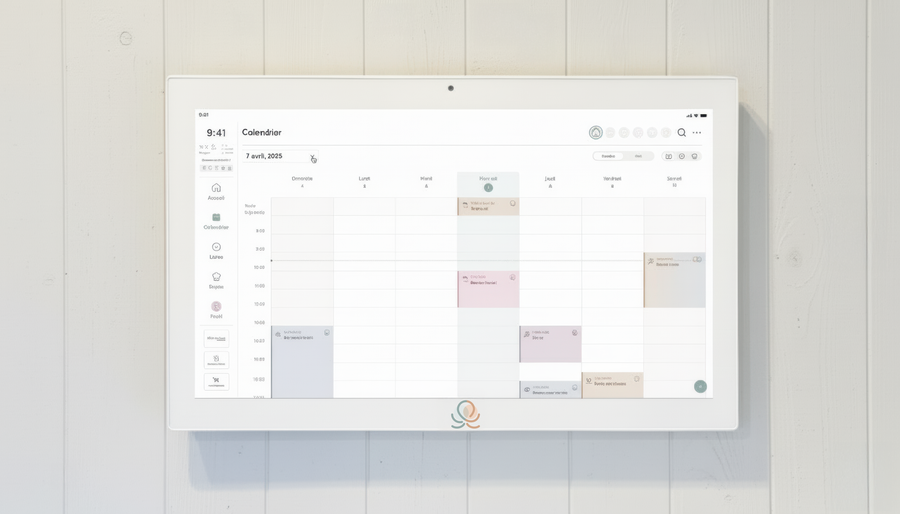
Put these tips into practice
Get the whole family organized with Octave
Meals, chores, the calendar and routines for the whole family in one place: on everyone's phone and on the Station on your wall.
The app is free on iOS and Android.