



Overheating family calendars: diagnosis and first aid
01 April, 2025
By Dominique Bernèche
Let's be frank – I fell into my own trap, and maybe you have too. Planning tools like Octave are extraordinarily powerful when it comes to simplifying our lives. They offer a clarity of organization and a smoothness we had never known before. But like any powerful tool, they're double-edged. By freeing my mind and giving me a clear view of my available time, these wonderful tools also opened the door to a temptation: filling every last bit of freed-up time with new ambitions.
Behind the carefully organized screen of my app, I have to admit an uncomfortable truth – I sometimes twisted the original purpose of these tools. I wanted to lighten my mental load, but I ended up using the efficiency I'd gained to do even more. The tool isn't the problem – quite the opposite, it works perfectly – it's the way I used it that turned a solution into a new challenge.
Do you recognize yourself in this situation?
I have to stay vigilant at all times: that's what I keep repeating to myself like a mantra. The kids are growing up and becoming more independent, but curiously, instead of freeing me up, this change pushed me to take on even more. My partner and I have become organization champions, real pros at family efficiency. But here's the irony: the more organized I get, the more I allow myself to take on. A seat on the chamber of commerce board? Of course. The school governing board? Why not. Extra clients? I've optimized my time, after all.
And the result? The calmer life I was aiming for keeps drifting further away the more I chase it. Every minute gained by my brilliant organization is immediately sacrificed on the altar of a new responsibility. I'm just as out of breath as before, but with an even longer to-do list. The list keeps growing, and with it that stubborn feeling of failure when my ambitions run up against my human limits. What irony, to feel like a failure at the very moment I'm constantly pushing those limits, at the very moment I'm perfecting my efficiency day after day.
I'm not alone in this trap. Many of us adopted organizing tools with the promise of freeing up our time and our minds, only to end up filling those spaces with even more obligations.
The trap of endless efficiency
The real danger doesn't come from the tools themselves, but from the illusion they create: the illusion that we can, and therefore must, do more and more. What starts out as a quest for organization turns into an endless race to “optimize” every moment. I started out with the laudable intention of structuring my daily life better, but I ended up seeing every unscheduled minute as a flaw to be fixed, an empty space to be filled.
The drama unfolds when we start imposing more on ourselves than we can truly handle. Driven by legitimate aspirations – being good parents, giving our kids enriching experiences, succeeding professionally – we find ourselves in a state of chronic exhaustion. We want it all: a fulfilling career, an immaculate home, kids involved in multiple activities, homemade meals, quality time... And we pay the price for these unrealistic expectations that we place on ourselves.
This pressure we inflict on ourselves often spills over onto our kids. Out of love and with the best intentions, we want to give them every opportunity: music, sports, tutoring, cultural outings... Without realizing that what we see as enrichment can become a source of stress for them and pull them away from their basic needs for free time and unstructured play.
In this frantic race where every minute seems to have to pay off, where notifications never stop reminding us of our commitments, building a balanced family schedule is a real challenge. Yet it's precisely in this context of constant acceleration that we need to learn to create breathing room. Not as an occasional luxury, but as a vital necessity for preserving balance and joy in our homes.
Between organization and flexibility
The first mistake many of us make is confusing an efficient schedule with an overloaded one. A good family schedule isn't measured by the number of activities it contains, but by its ability to support our well-being while letting us accomplish what really matters.
Sophie, a mother of three whom I had the pleasure of coaching, shared a realization with me that shook her: “I used to see the empty spaces in our family calendar as opportunities to add new activities. Until the day my 9-year-old said to me, looking tired: ‘Mom, can we just stay home? I'd like to keep working on this Lego build that I never have time to finish.’ That simple request made me realize that, thinking I was doing the right thing, I was stealing from my kids their right to creative boredom.”
Tools like Octave are remarkably powerful for coordinating our complex lives. But that power demands discernment. The question is no longer “How can I do more thanks to this tool?” but “How can this tool help me do better, with less stress and more quality moments?”
The winning equation isn't to keep adding more and more activities, but to subtract the nonessential and focus on what matters most. Knowing where to stop, what to give up, and how to temper our expectations becomes as crucial as knowing how to organize.
A schedule that breathes rests on three fundamental pillars:
-
Clearly defined priorities: telling what really matters apart from the rest
-
Protected pockets of freedom: deliberately scheduling the unscheduled
-
Embraced flexibility: accepting that not everything always goes as planned (and that this is perfectly fine)
Identifying our family's real needs
Before launching into yet another reorganization of our family schedule, let's take the time for some collective reflection. Every family is unique, with its own rhythms and aspirations. A few essential questions to explore together:
-
Which moments do we enjoy most in our family life?
-
Which activities seem to drain us rather than recharge us?
-
Where do our recurring sources of stress lie in our day-to-day organization?
-
What are each family member's specific needs when it comes to personal time?
This conversation, adapted of course to the kids' ages, is a first step toward a more mindful organization. It helps shine a light on the gaps between our family aspirations and the reality of our often overloaded schedule.
Tools in the service of breathing room
In our era marked by the fear of missing out (the famous FOMO), creating a schedule that breathes calls for a different approach to our tools. No longer to fill every minute, but to consciously protect pockets of freedom.
Integrated planning apps
For connected families, apps like Octave simplify the management of shared time by syncing calendars. Here are a few strategies for making them allies of our balance:
-
Create “protected” zones: treat certain time slots as inviolable “family events.” Sunday mornings can be blocked off as family time in the shared calendar, with the same level of priority as an important medical appointment.
-
Analyze our rhythms regularly: make a habit of reviewing your past week at the end of each week. Identify the moments when you felt overwhelmed. This analysis lets you adjust future planning and avoid the same pitfalls.
Mélanie shares: “When I started using Octave, I was tempted to fill every available slot. But I quickly understood that the real power of the tool was letting me visualize our family rhythms so I could respect them better. The goal became choosing which time slots should stay empty, and defending them like treasures.”
The advantage of digital tools? The ability to explicitly schedule reminders for break times, turning technology into a guardian of our balance rather than a source of constant pressure.
The wall planner as a complement
A classic but still effective solution, the wall planner offers a tangible view of everyone's commitments. The trick to making it a “breathing” tool? A specific colour code for moments of freedom and relaxation. These slots aren't “empty” spaces to be filled, but essential appointments with ourselves.
“Our family schedule now has green zones that mean ‘protected free time,’” explains Thomas, a father of two. “These spaces are just as important as medical appointments or extracurricular activities. No one has the right to turn them into something else, except in a genuine emergency.”
The danger of hyper-efficiency
While modern planning tools let us optimize our time like never before, that very power is sometimes a trap. Some people, particularly those who already excel at organization, may be tempted to use this increased efficiency to impose ever more tasks and activities on themselves, rather than to create breathing room.
Others slide into over-planning in the hope that these magical tools will let them get past basic human limits. No system, however sophisticated, can create more than 24 hours in a day or generate unlimited energy. Knowing how to recognize and accept your limits then becomes as essential a skill as knowing how to plan.
Julie, during a support group on the mental load, shared this reflection: “I thought Octave was going to turn my chaotic life into a model of perfect organization. I planned impossible days, then felt guilty about not being able to do it all. I finally understood that even the best tool can't replace a realistic assessment of my capabilities. True mastery lies in knowing what we're capable of doing to improve our lives without turning them into a military-style schedule.”
In the next article in our special feature, we'll explore in detail the concrete principles of a schedule that breathes, including the 80/20 principle, along with practical methods for gradually building them into your family organization.
This article is part of our special feature “A Family Schedule That Breathes,” published in the April 2025 issue.
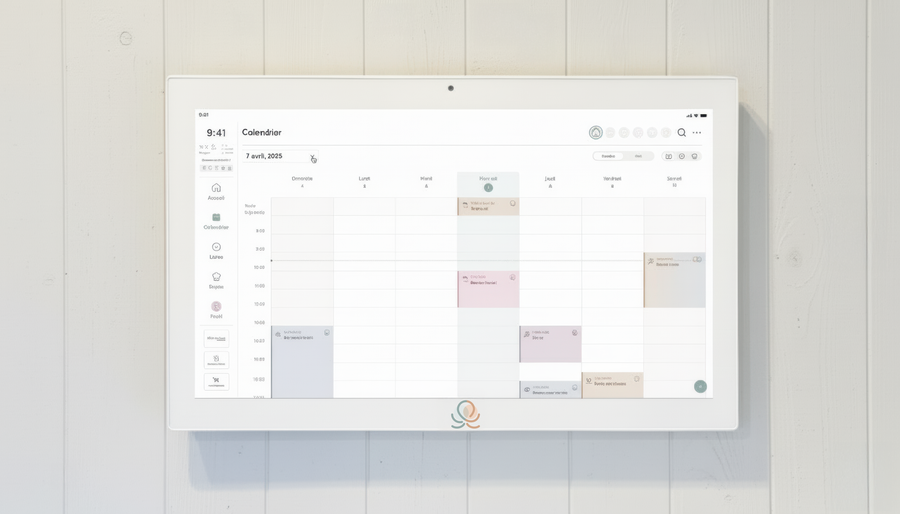
Put these tips into practice
Get the whole family organized with Octave
Meals, chores, the calendar and routines for the whole family in one place: on everyone's phone and on the Station on your wall.
The app is free on iOS and Android.