



Slowing down: giving yourself permission to do nothing this summer
06 June, 2026
A silent pressure weighs on many families as summer approaches: the pressure to use time well, to create memorable moments, to do enriching activities, to visit several places, to tick boxes on an imaginary list of what a beautiful family summer should be. And somewhere in this race for the perfect summer, we often forget to simply stop.
Yet slowing down (really slowing down!) may be the most precious gift we can give ourselves and our kids this summer!
The fatigue of the year that's ending
June often arrives with a level of exhaustion we downplay because we're used to running on reserves. A school year is ten months of wake-ups at set times, lunches to pack, homework to supervise, extracurricular activities to coordinate, meetings, forms, emails and a thousand daily micro-decisions. Not to mention work, household responsibilities and everything we carry outside the parenting role.
That fatigue doesn't disappear with the last day of school. It needs time to dissolve, and if we immediately replace the school structure with a summer overloaded with activities and planned outings, we never truly recover.
What doing nothing really brings
Doing nothing, or almost nothing, isn't a waste of time. It's an investment in something we can't manufacture any other way: restoration. For kids and adults alike, unstructured time lets the mind reorganize itself, creativity wake up, emotions regulate and the body recover from a sustained pace.
For kids specifically, summers with free time, mornings without a program and afternoons spent making up games, for example, are often the ones whose memories they hold most dear. Not the amusement parks or intensive camps, but the endless days in the yard, the improvised forts and the experiments cobbled together with whatever they have on hand.
For parents, slowing down also means remembering that you're a person outside the parenting role: a coffee sipped slowly, a book opened without a timer, a conversation with your partner that doesn't revolve around logistics. These moments seem trivial, but they're actually essential.
How to give yourself permission in practical terms
Giving yourself permission to slow down doesn't come easily. For many parents, it has to be a conscious decision, actively defended. Here are a few ways to put it into practice:
- Leave weeks intentionally empty in the summer schedule, with no camp, no planned activity, no obligation. That emptiness is precious, not something to fill.
- Resist social media comparison: other people's summers always seem fuller and more epic than yours. That's generally not reality, but rather a certain staging.
- Welcome your kids' boredom without immediately solving it. A bored child is a child a few minutes away from finding something creative to do on their own.
- Choose simplicity deliberately: a picnic in the yard rather than an organized outing, a board game night rather than a planned activity, a day at the beach with no itinerary.
- Protect your mornings: slow mornings, with no alarm and no rushing, are often what kids and parents alike remember as their sweetest summer memories.
The value of the ordinary summer
The most precious summers aren't necessarily the fullest. They're often the slowest, the ones where time stretches out, where no one watches the clock, where the days resemble each other a little but each has its own particular colour.
Allowing yourself to do nothing this summer means choosing to truly recover. It means giving your kids the rare gift of free time and relaxed parental presence. And it may mean arriving in September with something you haven't had in a long time: momentum!
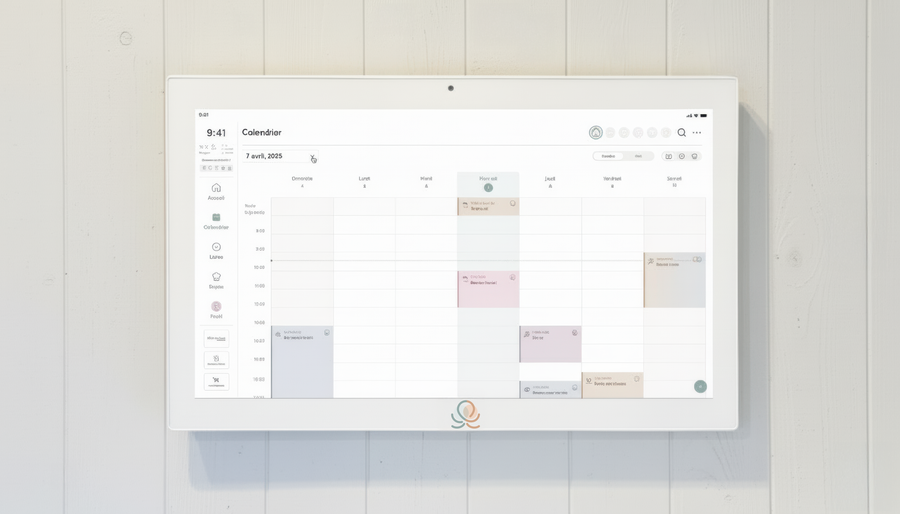
Put these tips into practice
Get the whole family organized with Octave
Meals, chores, the calendar and routines for the whole family in one place: on everyone's phone and on the Station on your wall.
The app is free on iOS and Android.